Think about the last time a joke taught you something. Maybe it was on social media, in a comedy sketch, or inside a meme. You laughed, but beneath the humor, you learned. That’s the power of satire. It entertains, and it informs. Or at least, that’s the intention. But not all science jokes land the same way, and some might actually do more harm than good. A 2024 study published in the journal Science Communication explored this idea, investigating how different forms of satire impact the credibility of podcast clips on renewable energy innovations like enhanced geothermal systems.
Dr. Isabelle Freiling, the study’s lead author and Assistant Professor in the University of Utah’s Department of Communication, explained that understanding message credibility is essential to effective science communication. According to Freiling, how audiences perceive credibility often depends on their preexisting values and beliefs, meaning what works for one group might not work for another
“It’s not enough for information to be accurate for people to use that information,” Freiling said. “They also need to see how it is relevant to them, and it needs to fit their values and beliefs, for example.”
The Experiment
To explore these dynamics, Freiling and her team designed an experiment involving nearly 800 participants who listened to podcast-style clips about enhanced geothermal systems. Some participants listened to clips that presented straightforward scientific facts. Others listened to clips that incorporated satire — a type of humor defined as “making a fool of or poking fun at well-known things, situations, or public figures” — in one of two types: either gentle and lighthearted (Horatian) or more harsh and edgy (Juvenalian). A third group, the control group, listened to clips that contained no humor.
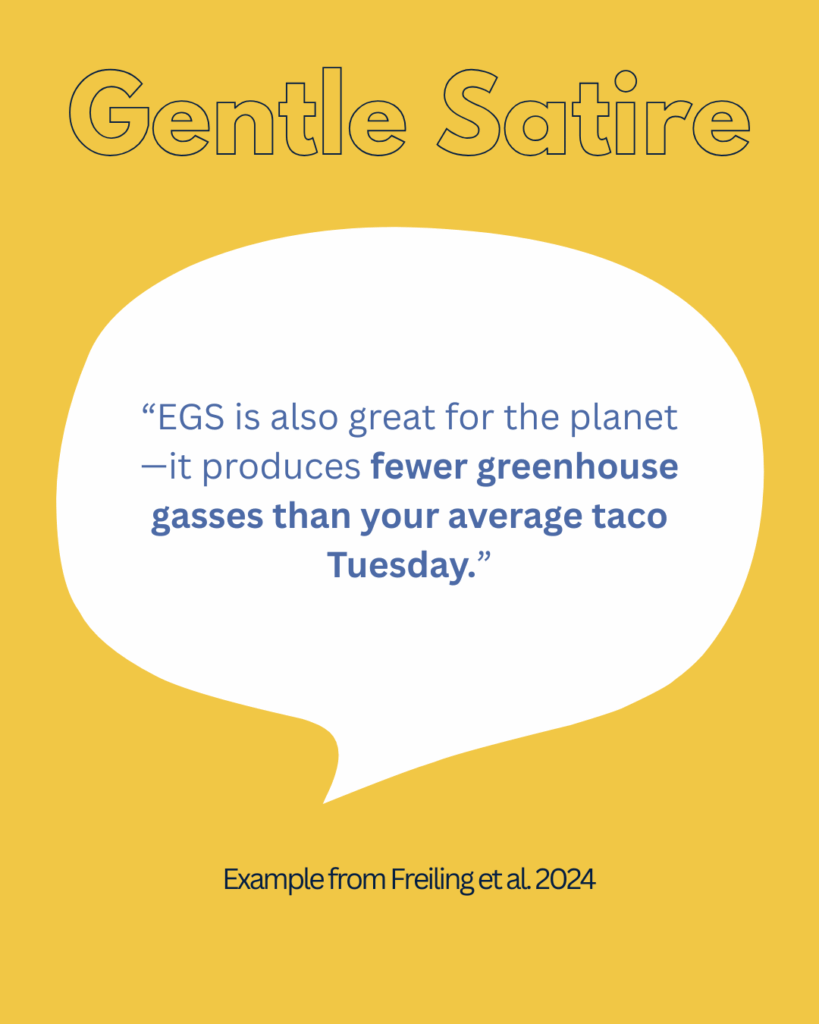

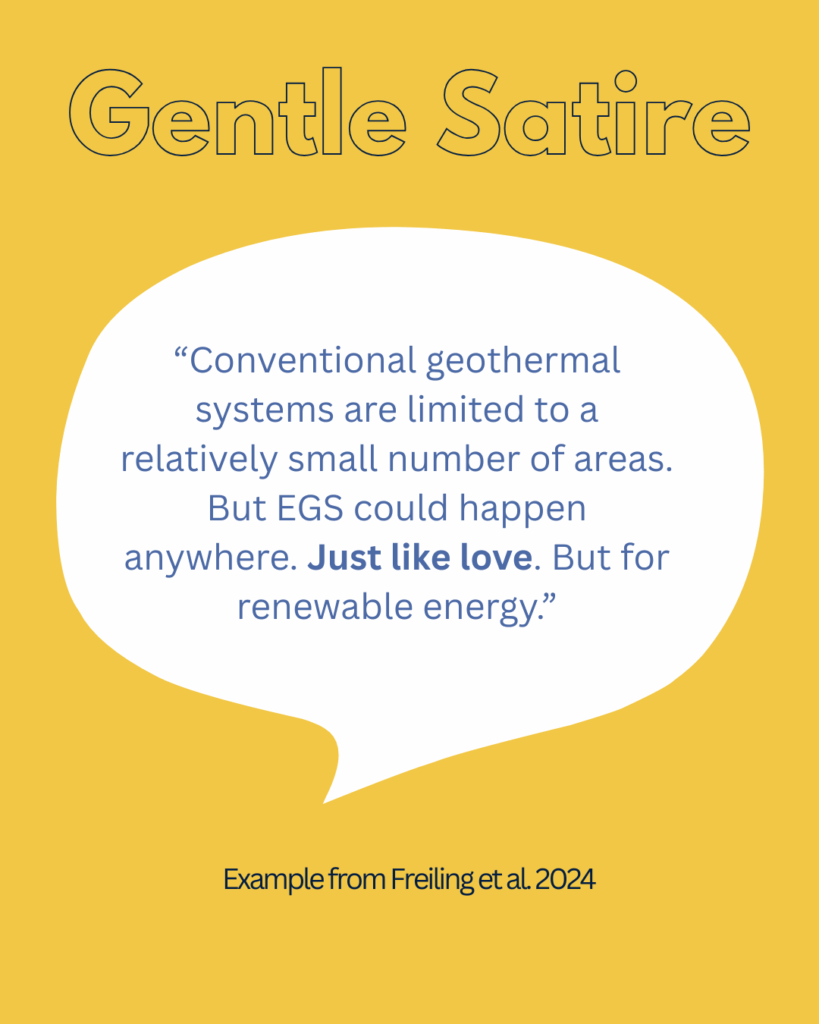
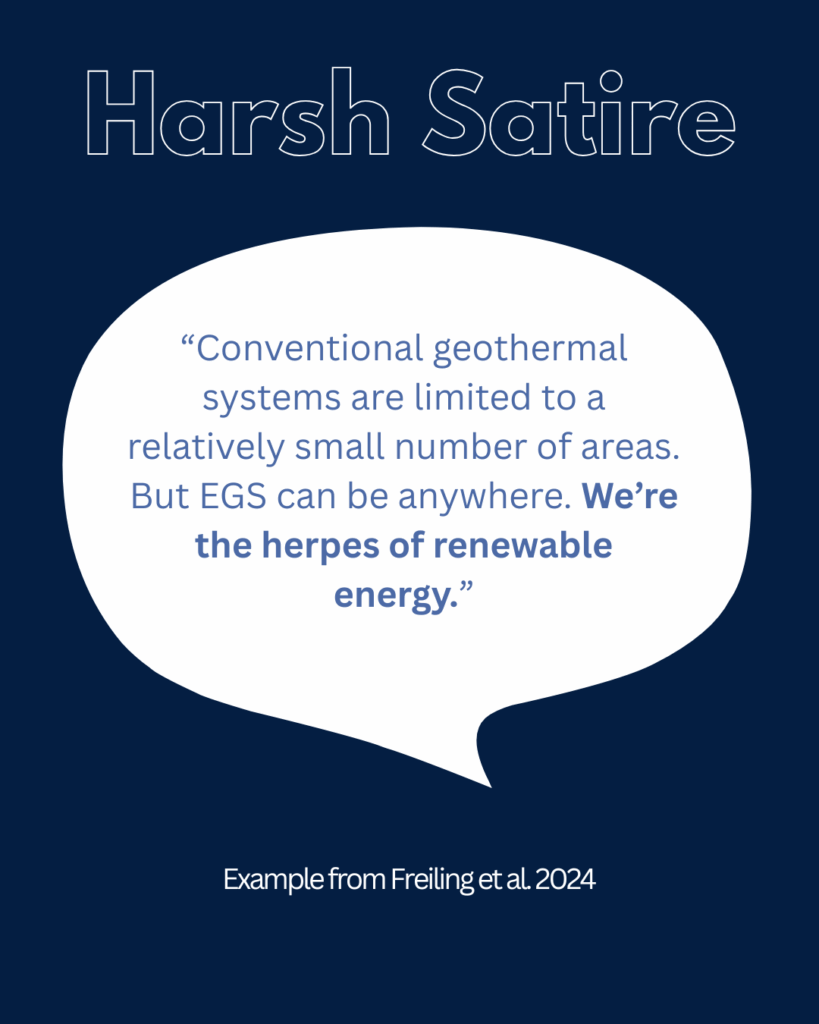
Examples of harsh and gentile satire used in the research study by Freiling et al. 2024. Gentile satire consisted of what the research team determined to be good-natured jokes; harsh satire consisted of more biting remarks. Credit: Hitchcock Project.
The researchers were interested in how these tones influenced two outcomes: the perceived credibility of the message, and the likelihood that listeners would use or share the information. This second factor, which they call “information reliance,” reflects whether a message can actually shape behavior, attitudes, or conversation.
Freiling emphasized that humor is often praised for making science more engaging. However, engagement alone may not be the only goal. A message that gets attention but erodes credibility might do more harm than good. This is especially true in science communication, where the stakes are high, ie, the consequences of getting it wrong are serious.
Did It Work?
The results revealed a clear difference between the two types of satire. Harsh satire often backfired. While it might entertain (which this study did not measure), it made participants more skeptical of the message. Freiling noted that when humor is too sharp or sarcastic, it might make audiences question whether the information is serious or credible. It’s similar to hearing a joke in the middle of a serious discussion. You might laugh, but the message loses weight.
Gentle satire, on the other hand, held up much better. It didn’t boost credibility, but it didn’t damage it either. According to Freiling, this kind of humor, therefore, has the potential to keep the audience engaged without losing credibility. The study also found that when people perceived the message as more credible, they were more likely to want to rely on the information. Thus, the subtle difference that the two satire types in this study make regarding credibility can determine whether people actually rely on the information later or simply dismiss it.
What It Means for Science Communicators
This study challenges the idea that all humor is helpful. In today’s fast-moving media environment, science communicators face pressure to grab attention. Humor can be a useful strategy, but only when it’s used carefully. Freiling emphasized that tone makes a critical difference. If the goal is to reach people with credible information, communicators need to be especially thoughtful about the kind of humor they use. Freiling also pointed out that the source of the humor may matter, and that this study used a scientist as the source.
“When scientists themselves use satire, audiences might expect a tone of neutrality and objectivity,” Freiling said. “As a result, a joke from a scientist may be interpreted very differently than the same joke told by a comedian. So, future research could test whether the results would be the same for other sources like comedians or science communication practitioners.”
For scientists who want to use humor effectively, Freiling recommended staying within the boundaries of gentle satire. This approach helps maintain credibility and opens space for dialogue without risking confusion or distrust. Because, as the study showed, credibility is closely linked to action, people are far more likely to use information when they find it believable.
Bottom Line
Humor has real value in science communication, but its impact depends on delivery. Gentle satire offers a way to make science accessible without undermining its importance. Harsh satire might get attention, but it can also erode credibility and derail the message. In Freiling’s view, humor should be used with purpose and precision.
This study also opens the door to further research. Freiling noted the importance of exploring other forms of humor and understanding not just their effect on credibility, but also how they influence engagement. There may be forms of humor that both entertain and build trust, offering science communicators the best of both worlds.
At the end of the day, science communication isn’t just about making people laugh. It’s about making people listen—and helping them care enough to act.
Read the study
Freiling, I., Cacciatore, M. A., Su, L. Y.-F., Yeon, J., Park, S., Du, W., Zhang, J. S., Yeo, S. K., & Siskind, S. R. (2024). Communicating About Renewable Energy With Satire: The Influence of Gentle and Harsh Humor Tones on Perceived Message Credibility and Information Reliance. Science Communication, 47(4), 471-496. https://doi.org/10.1177/10755470241293361 (Original work published 2025)
Abdulmalik Adetola is a master’s student in the Media Innovation and Journalism program at UNR and a graduate assistant for the Hitchcock Project. He is a passionate advocate for health literacy and digital communication, dedicated to promoting accurate and accessible health information in the modern age.