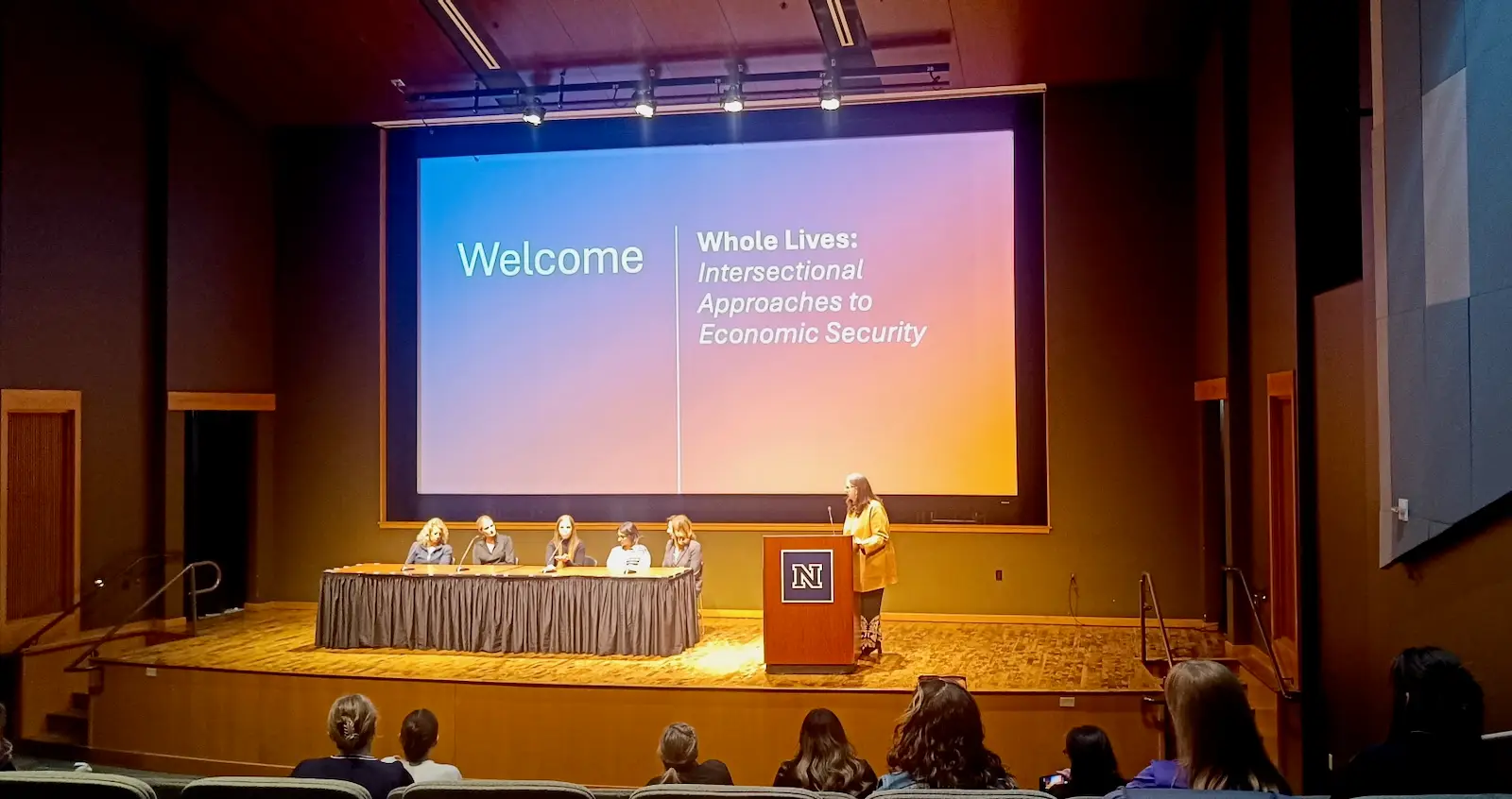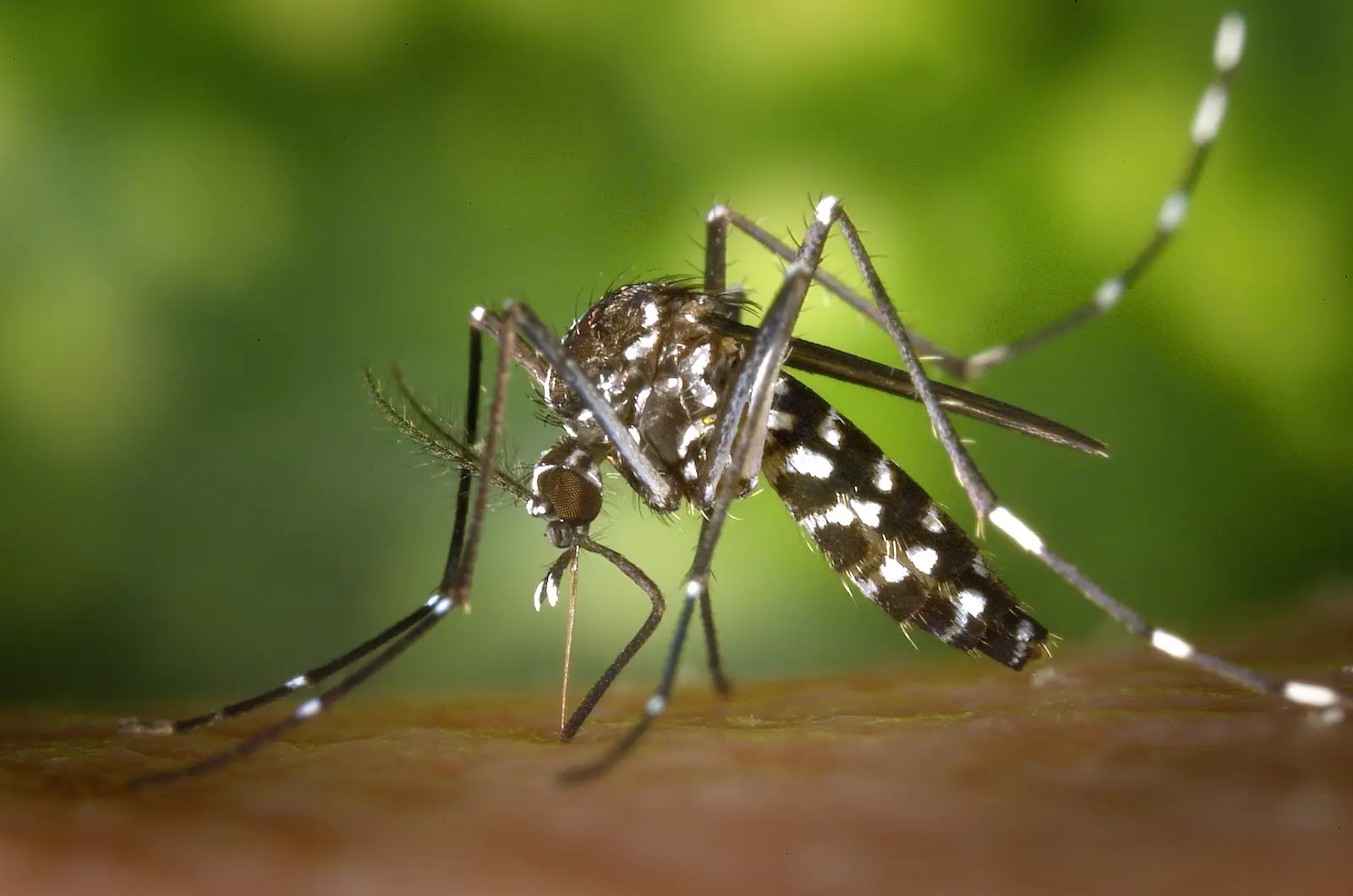
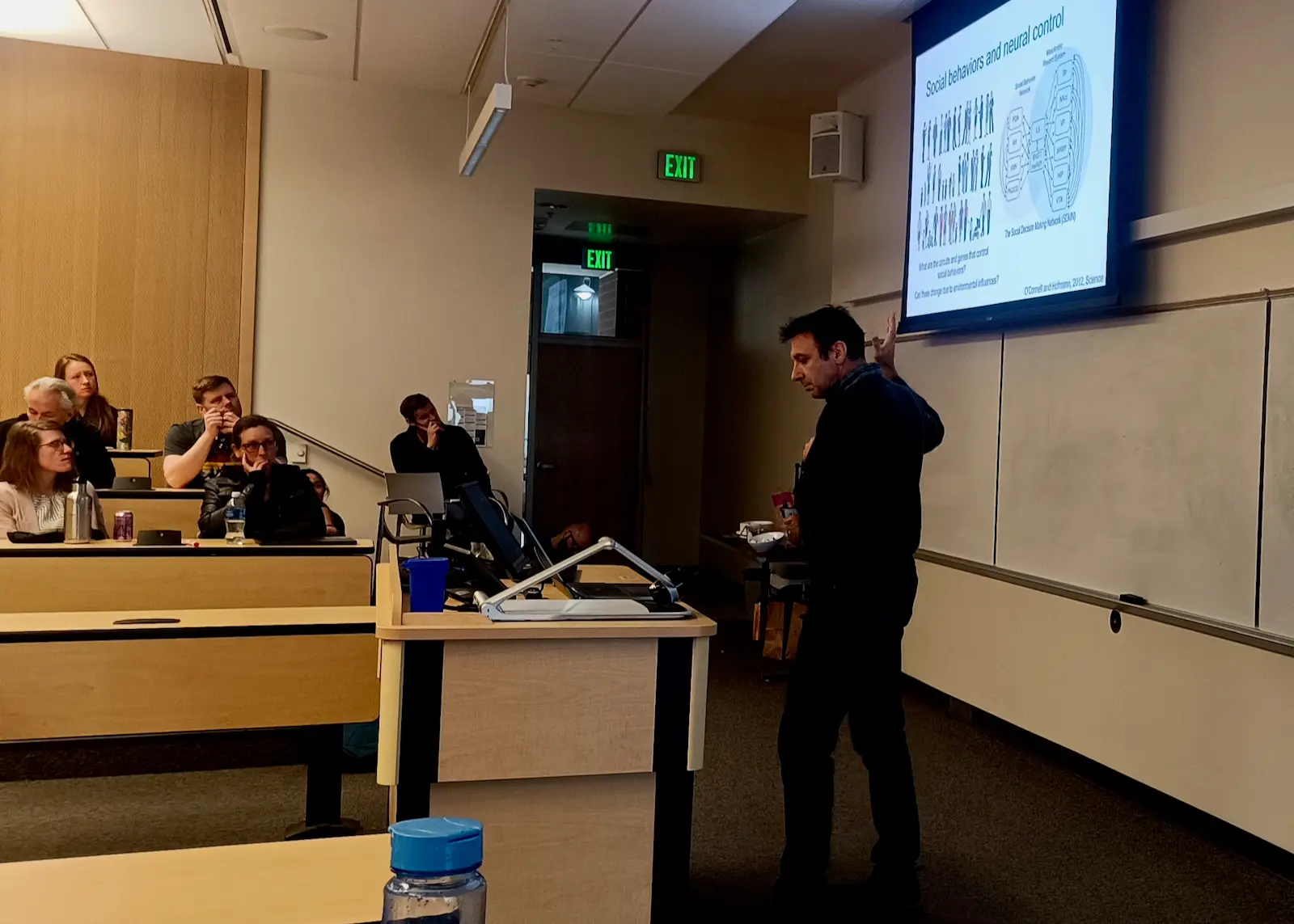
Above: Climate change and pollution may threaten zebrafish populations, according to a talk by scientist Philip Washbourne at UNR on March 5. Credit: Alex Mounde.
A visiting neuroscientist from the University of Oregon told researchers at the University of Nevada, Reno that a tiny, thumb-sized zebrafish may offer important clues about how brains control social behavior and how environmental changes could affect animal reproduction.
Philip Washbourne, an associate professor of biology at the University of Oregon, presented his research on March 5 at UNR’s Ecology, Evolution & Conservation Biology Colloquium. His talk, titled “Social approach circuits, sex, gender and a changing environment (The social lives of zebrafish),” explored how neural circuits, microbes and environmental stressors influence social and reproductive behaviors in fish. The talk drew on more than a decade of his laboratory’s published research.
Washbourne said environmental changes may also affect these systems. Rising water temperatures and pollutants such as dioxin, an industrial byproduct, could alter hormone signaling, influence sex ratios in fish populations and potentially reduce reproductive success.
Washbourne said zebrafish naturally display strong social behaviors, often swimming close to other fish and adjusting their movements in response to nearby partners. In laboratory experiments, the researchers measured these interactions by tracking how fish oriented themselves toward each other and how their movements synchronized during social encounters.
His lab has also identified specific neurons in the zebrafish forebrain that appear to control this social affiliation. When scientists removed or disrupted certain neuronal populations, the fish showed a reduced tendency to approach and interact with others, suggesting those neurons form part of a basic social behavior circuit.
Zebrafish are widely used in biological research because their transparent embryos and relatively simple nervous systems allow scientists to observe development and brain activity in living animals. Researchers use the species to study genetics, disease mechanisms and neurological processes.
During the presentation, Washbourne also described how microorganisms living in the body, known as microbiota, can affect brain development and social behavior. Zebrafish raised without normal microbial communities displayed weaker social interactions and changes in neural structure, suggesting microbes influence how brain circuits form early in life.
The research also connects social behavior to reproductive biology. Washbourne’s team, in collaboration with the John Postlethwait lab, is investigating how certain brain cells regulate egg production and mating behaviors through chemical signals such as the hormone arginine vasopressin.
Although the research focuses on fish, Washbourne said the findings could help scientists better understand how social behavior develops across vertebrate species. Many neural pathways involved in social interaction are evolutionarily conserved, meaning they share similarities across animals, including humans.
Washbourne’s research is supported by The Kavli Foundation and the National Science Foundation through a program titled “Neurobiology in Changing Ecosystems.” Current members of his laboratory conducting this work include Alex Tallafuss, Sara Rezazadeh, Maren Price, and several additional graduate and undergraduate researchers at the University of Oregon.
The UNR colloquium series regularly invites scientists from other institutions to present new research on ecology, evolution and neuroscience.
Alex Mounde is a graduate student in the Reynolds School of Journalism. He wrote this news brief for the Hitchcock Project’s Science and New Media course during spring 2026.