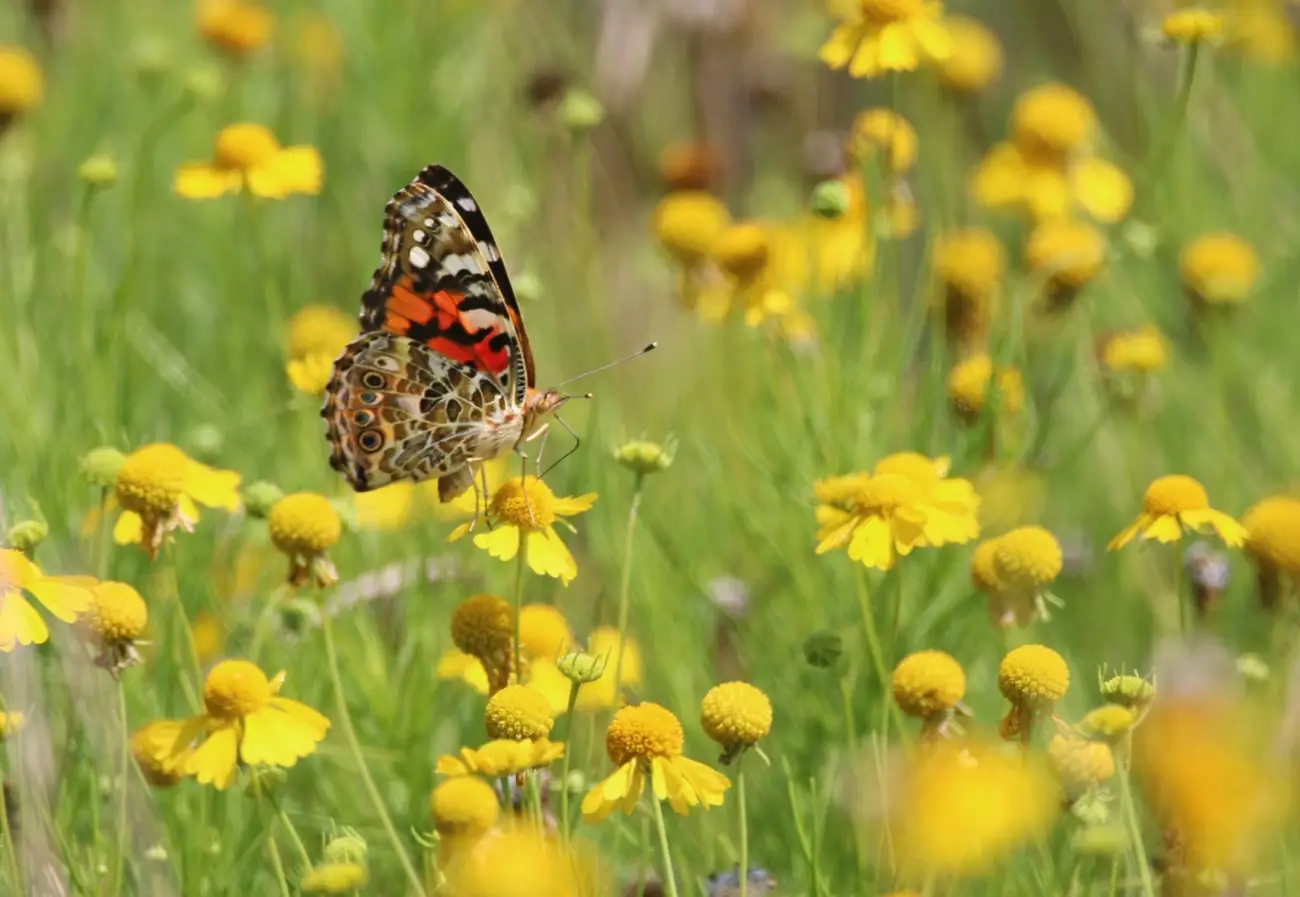
Above: A painted lady butterfly among yellow wildflowers. Credit: Debbie Koenigs/USFWS.
With pinkish-orange wings tipped with black and white spots, and a warm-brown body, the painted lady butterfly is a delightful garden visitor. While painted ladies in North America migrate annually in small numbers, they capture headlines with their irregular “irruptions” — flocks of butterflies that grow so large and dense that it becomes impossible to drive down a road without hitting dozens of them. What triggers these massive irruptions remains unknown, but Jolene Saldivar, a post-doctoral researcher at San Diego State University, is working to find out.
As of this March, flocks of tens of thousands of butterflies have been seen moving through California, winging their way past San Diego, visiting coastal beaches, and pushing toward the Pacific Northwest. Before this, the last painted lady irruption in North America occurred in 2019, making the events few and far between, but a cause for excitement and delight when they do happen.
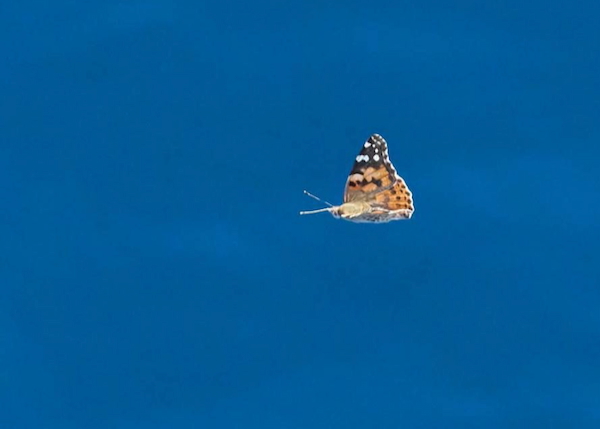
Painted ladies at sea. Credit: Armando Diaz.
These migrations originate in desert regions along the United States-Mexico border and extend northward into Canada, explained Salvidar during a recent presentation at the University of Nevada, Reno. Saldivar was in Southern California at the time of the 2019 irruption and witnessed the migration first-hand.
“It was really amazing to see swarms of painted ladies flying through,” Saldivar said.
The experience was so impactful that she switched the focus of her doctoral research from plants to butterfly migration, and has been hooked on the field ever since.
In addition to its beauty, the painted lady is extremely resilient and is known as the most widespread butterfly in the world. Painted ladies are well-studied in Africa and Europe, where their annual migration carries them over 9,000 miles, as multiple generations of butterflies make the trip from the sub-Saharan region to the Arctic Circle and back. However, their migration in North America is not as well understood and much less predictable.
Much of Saldivar’s work studying painted ladies relies on citizen science, particularly data collected on the popular nature-identification app iNaturalist. For one project, Saldivar and a team of researchers used pictures of butterflies nectaring on plants taken in California between 2005 and 2020 to determine which food sources they relied upon. To their surprise, they found 195 species of nectar plants that had not been previously known to host painted ladies. While they also collected spatial information during this project, it was not enough to answer the questions surrounding mass irruptions.
To do that, Saldivar looked further into the past, scouring historical records of painted lady migrations. Some records delighted her — for example, one from 1950s Arizona describing larvae as “very annoying.” Overall, Saldivar gathered 1,197 records from 1924 to 2023. Using this large dataset, as well as historical weather records, she is investigating potential drivers of irruptions. Her results indicate that wetter winters and early spring vegetation can lead to population buildup, which eventually triggers a mass exodus of butterflies that flows into western North America.
“I learned so much about this species by putting this dataset together,” Saldivar said.
Now, with the ongoing 2026 irruption, she’s getting to witness their migration once again — this time, as one of the foremost experts on the species.
While populous, the future of the painted lady is not guaranteed. Increased variability in weather caused by climate change will likely lead to increased migration unpredictability, and decreased rainfall in Southern California could impact the species’ ability to move through the state. However, planting a variety of nectar plants and documenting sightings of the species is greatly beneficial — both to the butterflies and to Saldivar, whose work celebrates the contributions of citizen scientists.
Katherine Johnson is a Ph.D student in the Ecology, Evolution, and Conservation Biology program. She studies mountain chickadees living in the peaks of the Sierra Nevada, but loves learning and writing about all wildlife. She wrote this story for the Hitchcock Project’s Science & New Media course during spring 2026 in the Reynolds School of Journalism.