The creator of Tumble Science Podcast for Kids reminds us that kids respond best when their intelligence and curiosity are respected.
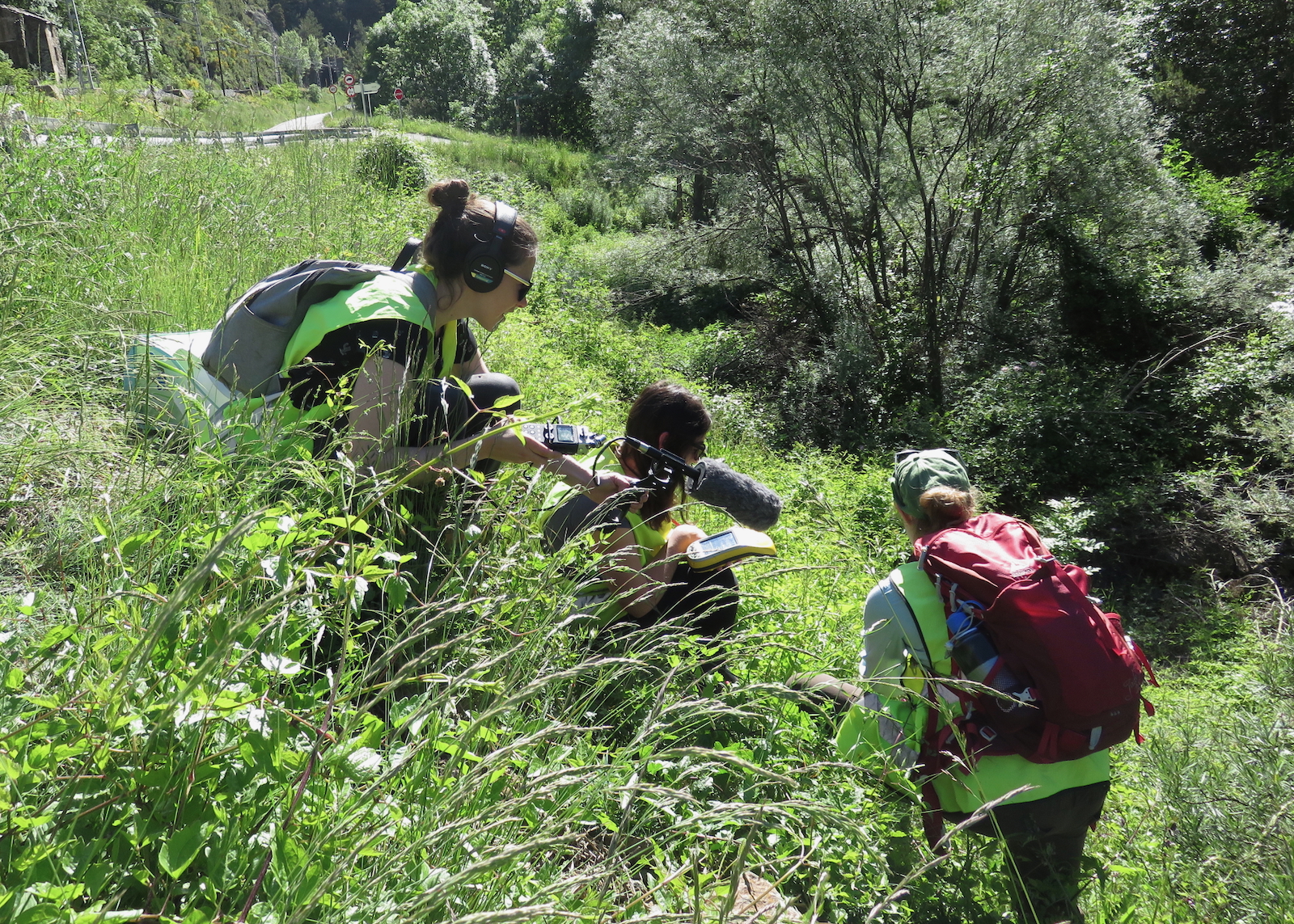
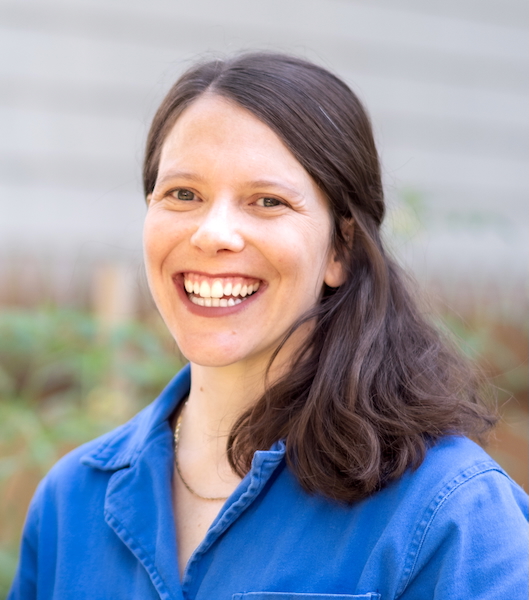
Above: Lindsay Patterson recording audio during a Pyrenees field trip with scientists studying snapdragons. Credit: Lindsay Patterson.
Science is full of questions—but how do you spark curiosity in kids without talking down to them? Lindsay Patterson, creator, co-host, editor, and executive producer of “Tumble Science Podcast for Kids” and CEO of Tumble Media, has spent a decade answering that question. With a background in science journalism and a love for audio storytelling, she has made it her mission to bring science to life for young listeners.
Through Tumble, Lindsay shows that science isn’t just a collection of facts—it can be fun, weird, and surprising; you just have to find a way to bring those elements forward. It’s a process of discovery made by real humans, like friends and neighbors, full of surprises, challenges, and creativity. Her approach respects kids’ intelligence and invites them to engage with science even if they don’t want to be scientists.
From humorous episodes about microbiologists collecting their own poop to stories about salamanders and capybaras, she demonstrates that curiosity and wonder are universal, and that representation matters. In this Q&A, Patterson shares her insights on storytelling for children, the importance of representation, and why science communication is more critical now than ever.
Q: Can you tell us about Tumble Media? What is it, and what do you produce?
Patterson: Tumble Media is a children’s educational audio company that grew out of starting “Tumble, the Science Podcast for Kids” in 2015. Right now, we primarily produce podcasts and conduct research on kids’ and family podcast listening, with a focus on STEM podcasts. We also do work-for-hire projects with other audio companies and are very interested in audio as a tool for education.
Q: Why did you decide to focus on kids?
Patterson: My background is in science journalism, always in audio—I came from radio. My very first job was working on a short-form science radio program where I had the opportunity to answer questions from kids. That experience made me realize two things: First, it’s really fun to write for kids. Second, I don’t have a science background myself, and when I was growing up, I was actively not interested in science. It wasn’t until I interviewed a scientist that I realized I had been missing the most interesting part of science—that it’s an ongoing process of trying to answer questions that matter to our lives and solve problems we care about. I fell in love with science reporting through that realization.
When I started writing for kids, I wanted to communicate that message to kids who might be like me—not necessarily interested in becoming scientists or engineers, but curious about how science connects to their lives. I also realized that many people are misled about science and don’t really understand how it works. If we can communicate that before people form fixed attitudes about science—before it becomes about belief rather than curiosity—that’s a really important opportunity.
Q: Did you choose the podcast format because of your journalism background, or was there something else behind it?
Patterson: I loved audio and wanted to make it. When podcasts started to take off around 2014, I realized it would be really hard to get a radio show about science for kids, but podcasting meant I could make whatever I wanted. I had the tools and the skills.
At the time, I was in a job that felt creatively frustrating, and I just wanted to make something of my own and put it out into the world. It took some trial and error to figure out the best way to tell the stories I wanted to tell and to communicate my message effectively in a podcast format.
Q: Over time, what have you learned are the best ways to tell these stories?
Patterson: We developed three core pillars for our storytelling. The first is humanizing scientists and showing science as a human process. Science is often presented as the work of geniuses making big discoveries, but that misses who these people are and the fact that science is still being done today by regular people—our neighbors and community members—making discoveries big and small. We center scientists’ voices and highlight their humanity.
The second pillar is showing the process of discovery. We build narratives around struggle, curiosity, emotion, and surprise. Science isn’t just about solving a technical problem—it’s connected to people’s lives, emotions, and persistence.
The third pillar shows that science is done by everyone. We try to illustrate the diversity of science and the many different kinds of people who contribute to it.
Q: How did you decide on the age range for the podcast?
Patterson: That happened pretty organically. We started making the show and listened to who responded. We heard from kids as young as three, often with help from their parents, and also from adults without kids who genuinely enjoyed listening.
Eventually, we settled on ages 6–12, even though that spans what child development experts often see as two distinct stages. People sometimes ask how such a wide age range can enjoy the same content. Kids understand it on different levels, but they really do listen and engage. Around age 12, many kids start gravitating toward more “grown-up” content, but we’re always welcoming new listeners.
Q: The storytelling principles you mentioned seem relevant for adults too.
Patterson: Absolutely! When I first started out, I was told that adults generally have about an eighth-grade understanding of science. In reality, it’s often much lower. If you communicate science in an engaging way—especially current science, framed around ongoing discovery—it becomes interesting to everyone. It feels new, not like something they learned once in school.
Q: What’s a common misconception about kids learning science?
Patterson: The biggest misconception is that you have to dumb things down. Kids can immediately tell when something is being dumbed down, and they find it boring. They don’t want content to feel “kiddy.” They want to be respected for their intelligence and creativity, or else it gets boring very fast. They want to feel like people are speaking on their level about things that interest them. It’s about making sure that the content is relevant to their lives, understanding their existing knowledge, and using analogies grounded in their experience.
Q: Can you walk us through your process—from finding stories to producing an episode?
Patterson: We’re in our 10th season now, so we’ve learned a lot about what kids respond to. We also collect questions from kids, which gives us a great sense of what they’re curious about.
Each season, we plan topics we want to cover. There are some themes we always include—like domestic pets—because kids love learning about animals they live with, like if dogs are really loyal, or what do they think. We then match those questions with scientists who not only know the answers but are actively working to figure them out. Or we just find scientists who are doing really cool things and just go and make an episode about them.
We conduct a one-on-one interview with the scientist, which becomes the foundation of the episode. As a non-scientist, I intentionally approach the story without pretending to be an expert. The scientist is always the authority.
I write the script, and my co-host Marshall doesn’t see it until we start recording. That way, his reactions are genuine, and he serves as a proxy for the listener. I play the teacher, he plays the learner, and the scientist’s voice stays at the center.
After recording, we create a rough cut and revise extensively until the story works. Marshall also does all the sound design and creates original music for every episode. From start to finish, one episode usually takes about a month and a half.
Q: What role does humor play in writing for kids?
Patterson: Humor is essential. It’s one of the things listeners comment on most. I love puns, and humor helps make complex or difficult topics more approachable. Science is already fun, weird, and surprising—you just have to bring those elements forward.
Q: Do you remember your first episode?
Patterson: Yes—it was called “The Mystery of the Barton Springs Salamander.” I interviewed one of my best friends about her PhD research on salamanders. It’s hard for me to listen to now because so much has changed in the sound and how we produce the show, but it’s still one of some listeners’ favorite episodes.
Do you have a favorite episode?
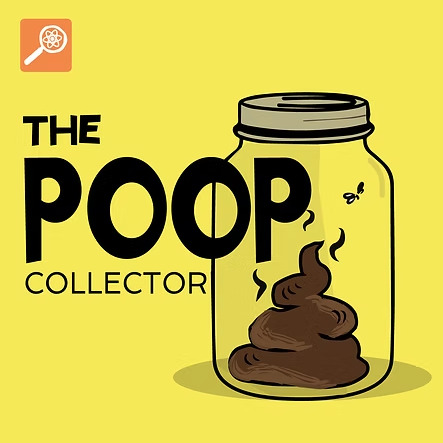
Patterson: I have many! One that comes to mind is “The Poop Collector.” Poop is one of my favorite subjects and this story really highlights how weird and how personal science can be. It’s about a microbiologist whose boss asked him to collect his poop every day for a year for a study. Inspired by the movie Yes Man, where the character has to say yes to everything, he said yes—and ended up on a stinky, strange, funny, and very personal scientific journey of examining his personal microbiome. It captures how weird, creative, and human science can be, as he faced challenges like once he was on an international trip and had to figure out how to get the poop home without melting because he was freezing it. If I listen to an episode and smile the whole time, those are my favorites.
You mentioned before that you want the podcast to show the sciences for everybody and from everybody. How do you approach diversity and cultural representation?
One of the things that started very naturally for us on our journey was a Spanish adaptation of Tumble, because we actually lived in Spain for four years. That’s where I met my friend Nuria, who was doing podcast creation—though for adults.
When the pandemic started, it was literally the day schools shut down. We were doing a Q&A with a doctor, along with friends from the school community. The school itself was Catalan-speaking, but my Spanish-speaking friends kept asking, “What did he say?” And I thought, Oh, maybe we should translate this. That’s really how “Tumble en Español” started.
Through that process, we realized there weren’t science podcasts in Spanish for kids, and no one else had done an adaptation from English to Spanish. From there, we began this broader journey of understanding: who is listening to the Spanish adaptation? How do we reach more people? That question became a guiding focus for us.
At the same time, we were recognizing how important diversity is in science. We wanted to represent people from all backgrounds and from different countries, and to show that everybody can do science. The scientists featured on our show also serve as role models for our listeners, and we’re very intentional about diversifying both the number and the kinds of role models that kids are exposed to.
Bringing it back to Spanish and bilingual podcasting, we really wanted to explore: if we’re going to do this in different languages, how do we integrate culture into the podcast as well? That’s what we’re trying to learn through a research project we’re doing with the National Science Foundation. We’re creating these episodes, having them evaluated by cultural consultants and a cultural advisory group, and then sharing them with families. Through that, we’re trying to understand what families think about the episodes and whether the cultural elements help spark science conversations in their homes—especially if those elements make the content feel more relevant to their lived experiences.
What are some examples of scientists featured in these episodes?
We’ve featured a Colombian PhD student studying capybaras, a Mexican veterinarian researching axolotls, a cat behavior expert called Mikel Delgado, a particle physicist called Jessica Esquivel exploring whether “nothing” can exist in the universe, and Shirley Murillo, a meteorologist who flies into hurricanes.
What advice would you give to students or creators interested in producing content for kids?
Think about what’s relevant and interesting to kids, but don’t limit yourself to traditional topics like dinosaurs and space—those can be gateways to deeper, more meaningful science. This work is a huge opportunity to shape how kids understand the world and how science works, even if they never become scientists. It’s a privilege, and it should be taken seriously.
Finally, why is science communication so important right now?
Science communication is important because there has never been a more critical time to talk about science and explain why it matters. We’re seeing science stripped away or dismissed because people don’t understand its value. Questions like why federal funding for science matters often go unanswered, even though that funding shapes the future of our country and directly affects people’s health—not just in the future, but right now.
Science is essential for our ability to adapt to and respond to major challenges, like climate change. If we don’t communicate why science matters, people won’t understand how deeply it affects their lives. And while this can feel heavy or even a little depressing, it also highlights how urgent this moment is.
We need to be much louder about the importance of science—not only for people who already believe in it, but for those who don’t yet understand it and will still feel its consequences. When people are confused about why they’re experiencing certain challenges, it often comes back to whether we value science and choose to invest in it.
Science communication is a very important job, and it’s not something only science journalists do. Some of the most impactful communication happens in everyday conversations—with friends, family, and communities—where people can explain why science matters and help others see its relevance in their own lives.
Learn more about Tumble Science Podcast for Kids at: https://www.sciencepodcastforkids.com/
Vanesa de la Cruz Pavas, M.A., is a science communication specialist for the Hitchcock Project. She is a graduate of the Reynolds School of Journalism’s class of 2023.