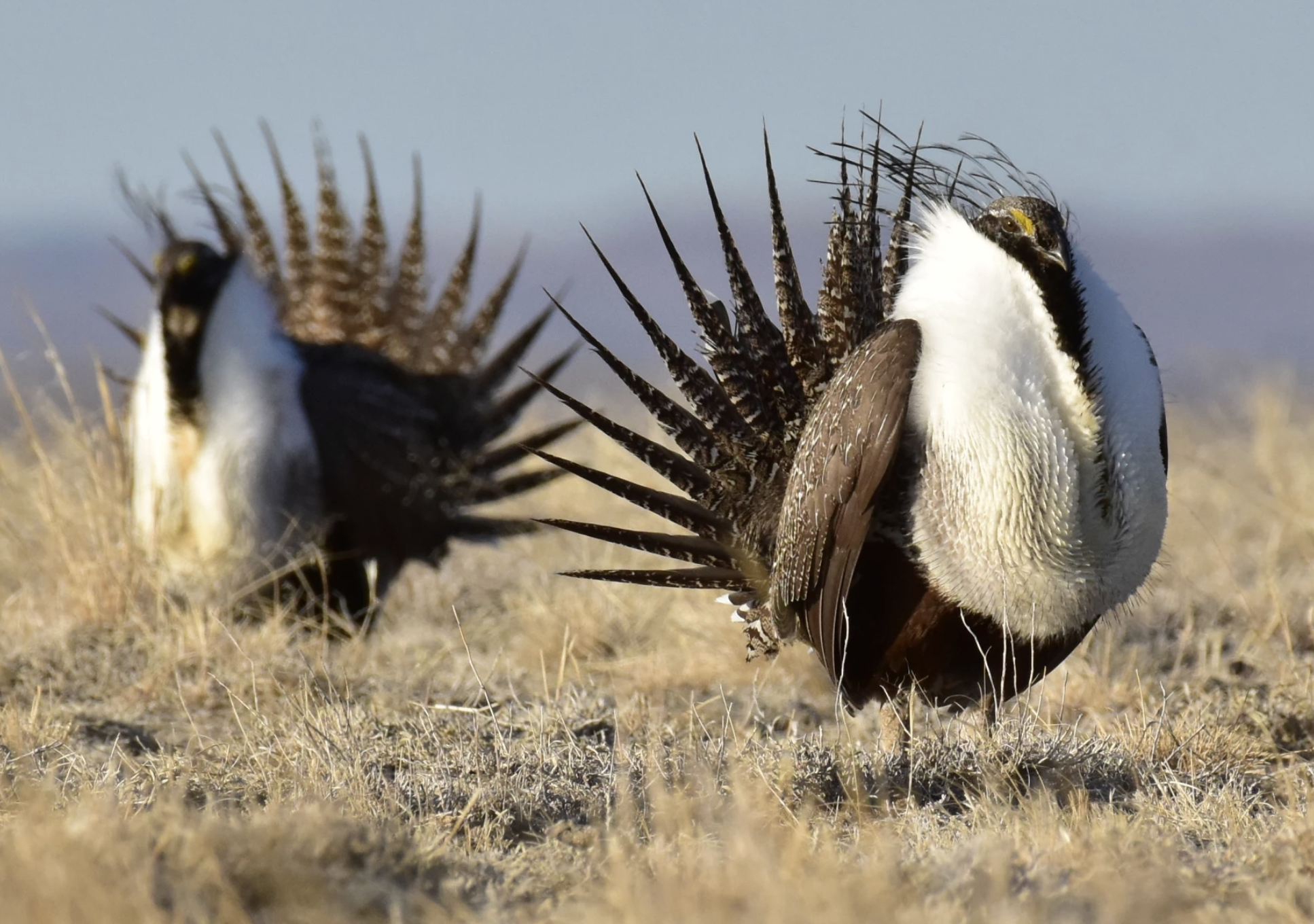
This story was shared with permission from KUNR Public Radio. For an audio version of the story, please visit the KUNR website. Above: Greater sage-grouse populations decline 2.3% on average every year, according to the North American Breeding Bird Survey. Credit: Tom Koerner/USFWS.
The dark spiky tailfeathers of Nevada’s endangered sage grouse stand out against a vast sea of sagebrush. Despite its sweeping presence, once sagebrush is lost, it becomes difficult to regenerate. Across the state, man-made disturbances from mining projects and land development also continue to close in on sage grouse habitat.
The Nevada Department of Conservation and Natural Resources offers a unique approach to wildlife conservation. Their Conservation Credit System works with land development projects to offset habitat loss through “credits.”
The credit system provides a framework for preserving sagebrush ecosystems long-term, said Kathleen Steele, with the conservation department.
“The loss is what we call debits, and then the replacement is called credits,” she said. “That can include pinion juniper removal, seeding, fire restoration, or cheat grass removal. Anything that brings back or restores sagebrush ecosystems.”
Steele said that the project has seen sage grouse populations slowly increase the last two years.
“Sage grouse are what we call an indicator species, which means that the work that we do for them also improves the habitat for other species. The work that we do also benefits mule deer and antelope and sage sparrows, pygmy rabbits, all of those species that are native to Nevada, that we all love,” she said.
The program aims to balance the state’s economic needs with responsible conservation of native species. Credit is determined case-by-case for private, tribal, and public lands, and last a minimum of 10-30 years depending on the project.
Lupe Alvarez is a graduate assistant for the Hitchcock Project for Visualizing Science in the Reynolds School of Journalism. She is the 2026 summer intern for KUNR and the Hitchcock Project for Visualizing Science