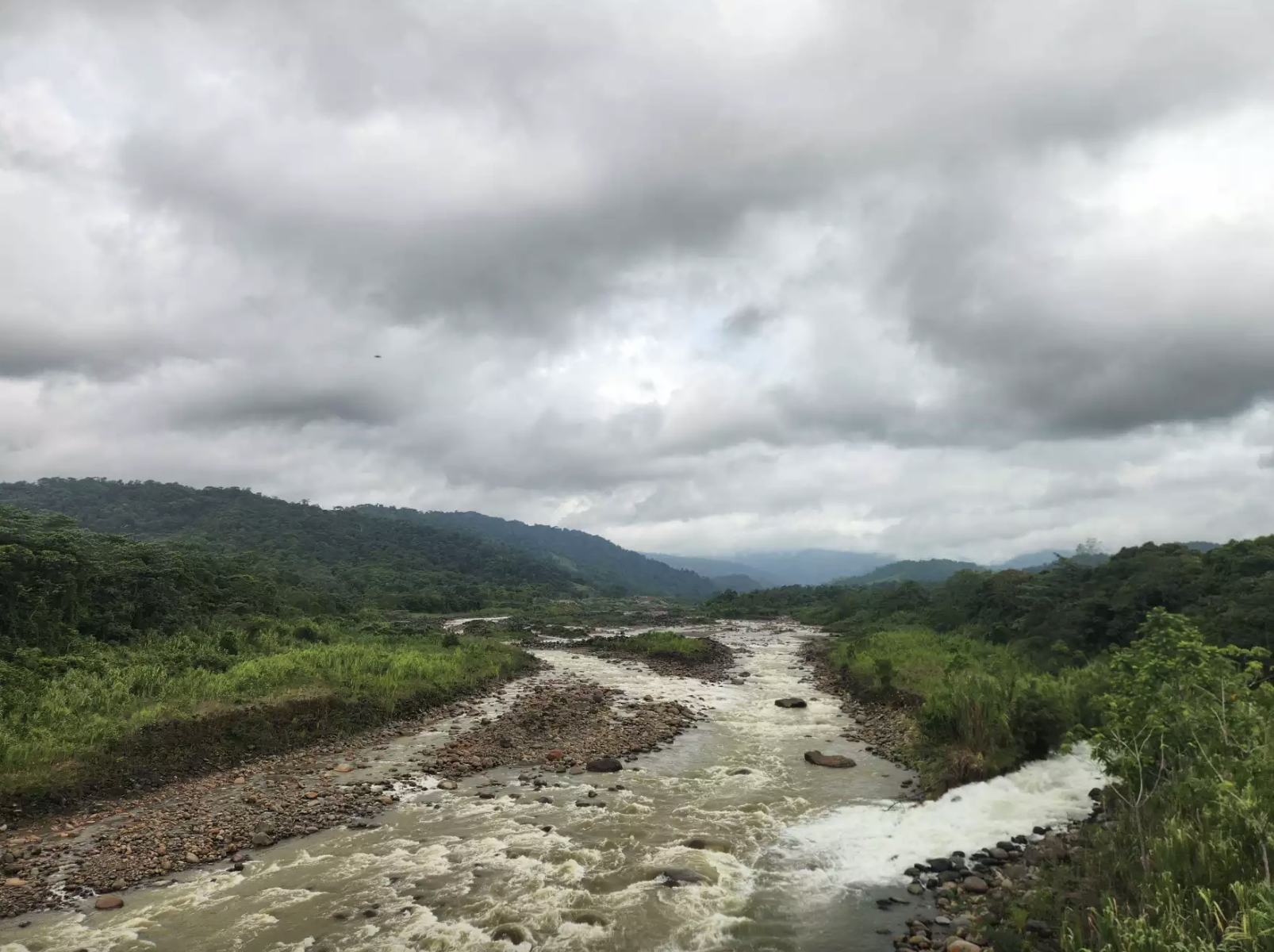
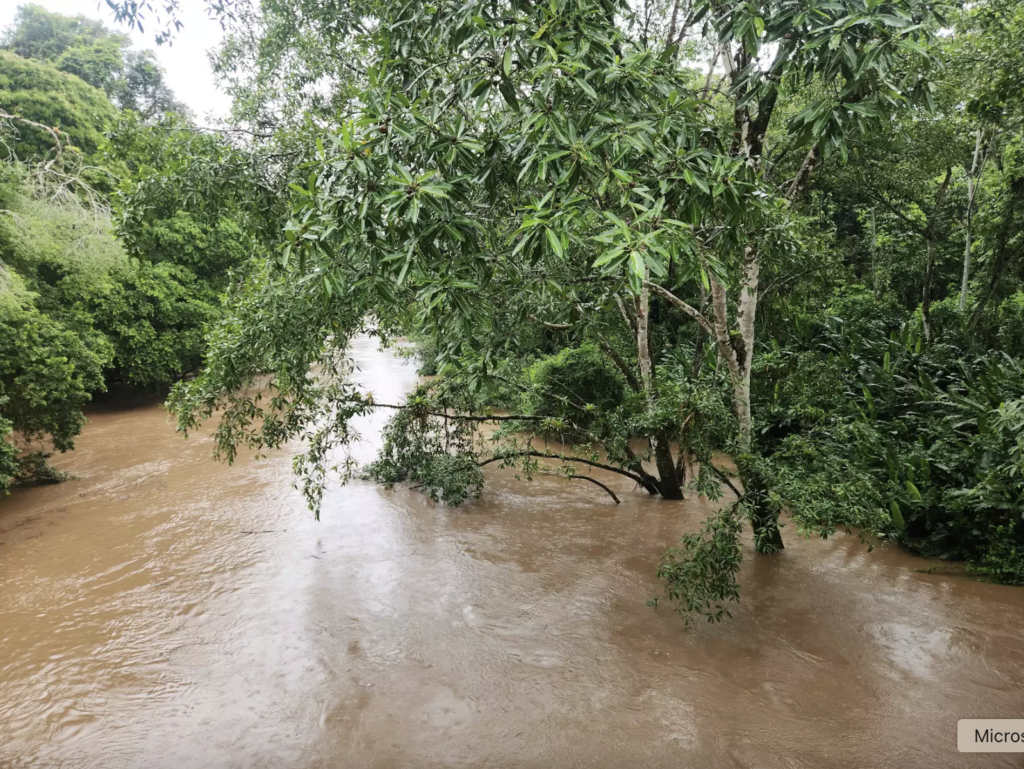
This story was shared with permission from KUNR Public Radio. For an audio version of the story, please visit the KUNR website. Above: The Sarapiquí River stretches for 53 miles. Recent heavy rainfall led to the river level increasing. Credit: Ally Ibarra-Soltero/KUNR Public Radio.
Costa Rica relies on rainfall for its water supply. But climate change is having a significant impact. Up until recently, Costa Ricans knew exactly when the rainy and dry seasons began and ended.
Ana Maria Duran Quesada, an applied physicist at the University of Costa Rica (UCR), said in recent decades she’s noticed precipitation has become more variable.
“You would normally have a well-distributed amount of rainfall during the rainy seasons, but what we observe now is a slight increase in the number of very heavy rainfall events,” she said.
Technically, Costa Rica receives the same amount of precipitation every year, Duran Quesade said.
Christian Birkel, a professor of hydrology at UCR, said the country is seeing heavier rainfall in shorter periods of time. This leads to extreme flooding and no way to capture the water for use. Most of the water ends up in streams and becomes unusable.
“Not only the flooding or the hydrological extreme of too much water, you get the opposite, the contrary scenario as well, when water is lacking. So the dry season in Costa Rica is now getting longer. And this is usually where you need water the most,” he said.
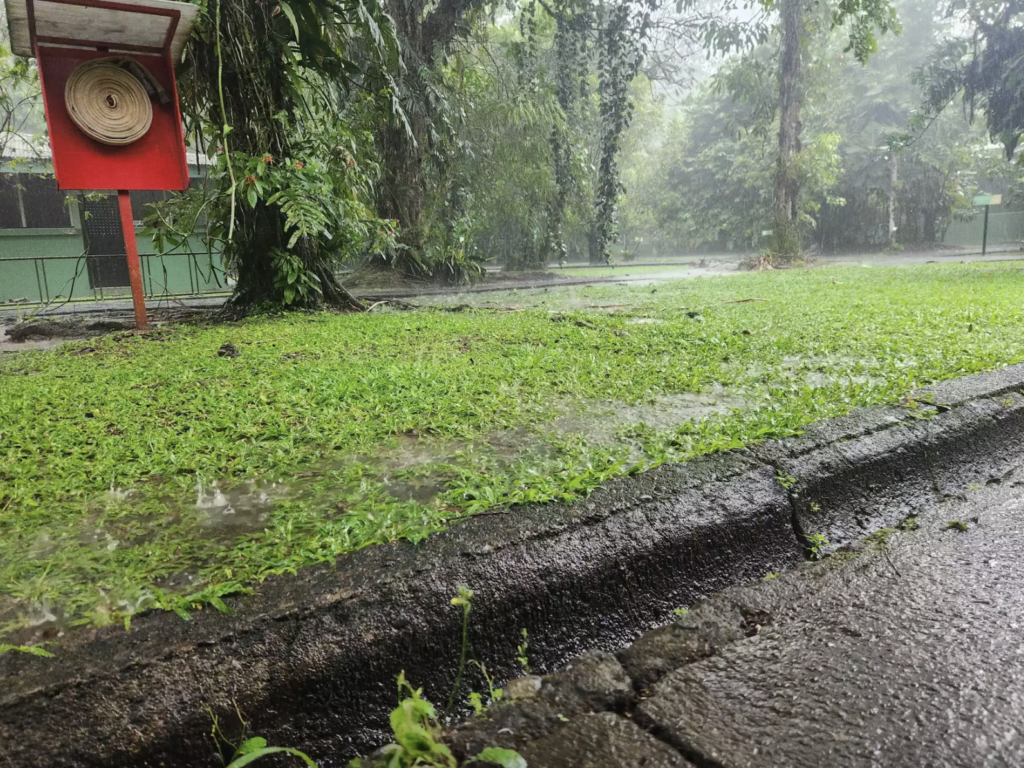
During these heavy downpours, it’s hard for the ground to absorb water.
Located on an over 3000-acre reserve lies La Selva Biological Station. Operated by the Organization for Tropical Studies, it’s a space where scientists can conduct research on the natural order of Costa Rica.
Danilo Brenes, a biologist, has worked at the research station for over 40 years. To get from the living area to the labs, you have to cross el Rio Puerto Viejo, using a wobbly suspended bridge.
Brenes remembers times when the river almost engulfed the bridge and roads because of heavy rainfall. And you’d have to leave the station by boat.
“When there are floods, the water is stronger, it flows faster, and there’s probably more destruction. So every time there are floods, you can see that there’s more destruction. And you can see it in the communities. In the jungle, no, because you don’t notice the damage,” he said in Spanish.
The research station has drains that redirect the water to the river. In the jungle, however, water can quickly accumulate.
The cities flood semi-frequently, with most impacts affecting bridges. Birkel said that creating a water reservoir and getting water to the people have been the top priorities.
“This is the type of adaptation measures that Costa Rica is currently implementing. But you also have financial restrictions. So the thing is that there should probably be a lot more done,” he said.
In 2018, Birkel and other UCR professors published a paper outlining their concerns with the changes in weather and the impact on their community. Since then, Costa Rica has acknowledged climate change, but no new funds have been made available for weather and water research.
“So we got funding, but not from Costa Rica. So, Costa Rica is definitely financially limited. There are not a lot of resources for research. So a lot of what we do comes from other countries, with support from Germany, the UK, for example, in part the States. But it’s been reduced,” he said.
Having a diverse set of data is critical for creating models to better understand what is happening with the atmosphere, Duran Quesada said.
“We are having these very large issues with the reduction in the number of observations, mainly when we have, for example, satellite coverage. There is questioning on whether should I keep this station if I can have the map from the satellite, but there is not really understanding that for that map to be accurate, and I need the field observations for the validation and the calibration,” she said.
Duran Quesada, Birkel and Brenes all worry about the changes in climate and its impact not only on humans but also on our planet. But they also believe it’s not too late to make a difference.
Ally Ibarra is a student in the Reynolds School of Journalism and a student reporter for KUNR. She produced this story in partnership with KUNR as part of the Hitchcock Project’s spring 2026 travel reporting course to La Selva Research Station in Costa Rica.