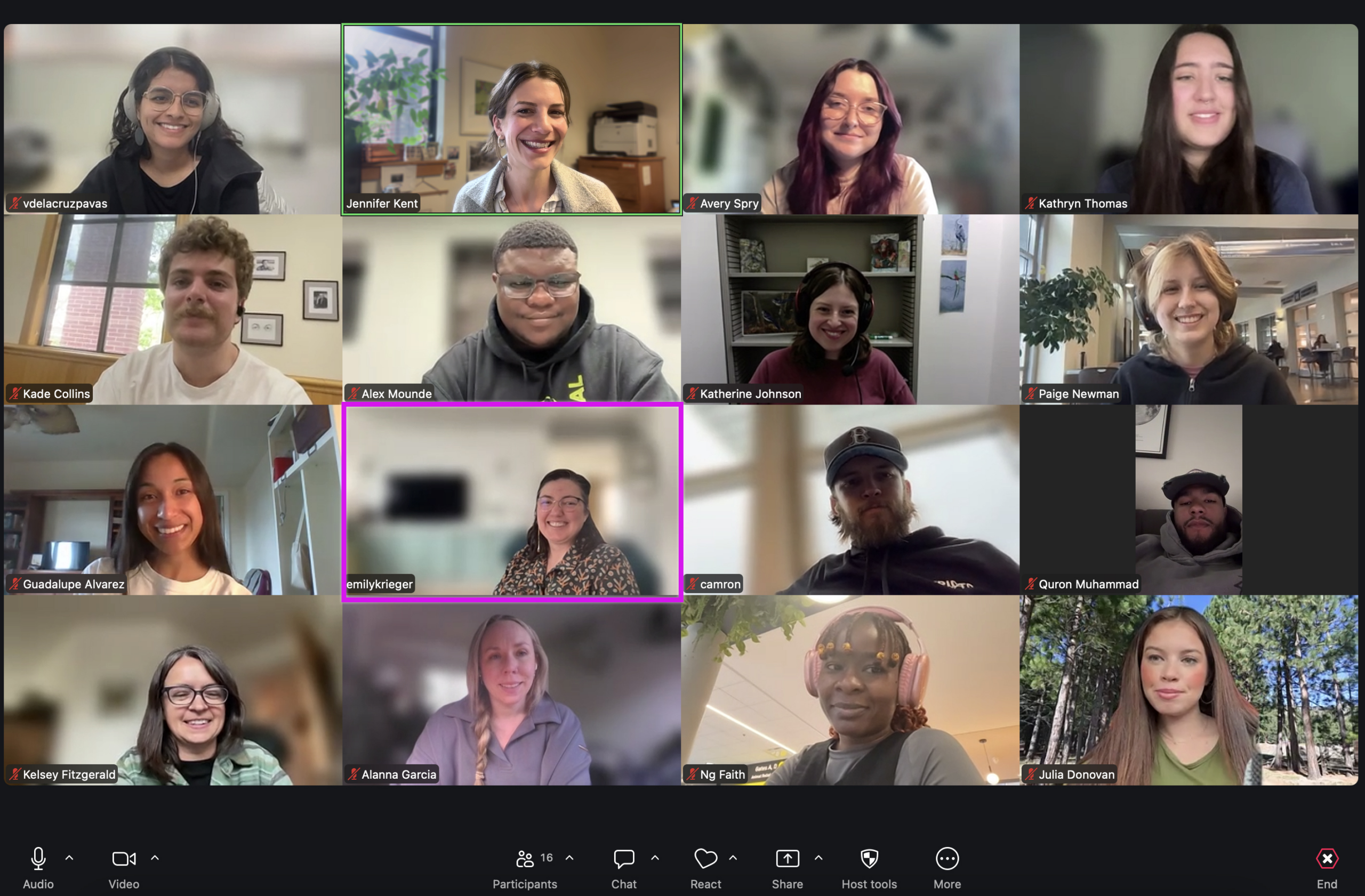
Above: Professional fact-checker Emily Krieger (outlined in pink) talks with Reynolds School students over Zoom in March 2026. Credit: Jennifer Kent.
Publishing any form of science writing requires an important step: fact-checking. Whether for children’s textbooks, New York Times bestsellers, or award-winning podcasts, the role of a fact-checker is crucial in ensuring that every sentence is grounded in verifiable information. Recently, award-winning fact-checker, editor, and writer Emily Krieger met with the Reynolds School of Journalism’s Science and New Media class via Zoom to discuss her job and the importance of fact-checking in today’s media landscape.
Krieger’s career in fact-checking began with National Geographic in 2002. In the years since, her clients have included The Atlantic, the podcast Radiolab, and the authors of more than 25 books.
Writing a book can be a daunting, expensive, and lengthy process, even for those with years of experience. One thing Krieger finds rewarding about being an independent fact-checker is the relationships she builds with authors, whether they’ve published before or are looking to get their work out into the world for the first time. Fact-checking gives both Krieger and the authors confidence that every sentence written is rooted in fact, while also balancing an author’s creative vision.
“It’s a very personal one-on-one relationship,” Krieger said. “You get to choose people that you feel like you want to trust-fall with and be their support person. It’s a nice thing. You get to exist outside of all the turmoil that goes on in all the media.”
As newsrooms across the country undergo changes, consolidate, or close, fact-checking remains a critical step in communicating accurate information to the public. The spread of misinformation presents challenges that affect our whole society, highlighting the importance of the work that a fact-checker does.
”If you value fact-checking, try to support it however you can and spread the word, because they do go the extra mile,” she said.
Krieger described how she approaches fact-checking for podcast episodes like Radiolab’s “Return of the Flesh-Eaters” by thoroughly listening first, and letting the story “marinate” before digging deeper to address and verify any superlatives, conflicting crediting, and claims that may be problematic.
For example, in that podcast episode, a statement that the first person to observe that female screwworm flies mate only once was found to not be the episode’s protagonist Edward Knipling, but his colleague G.W. Eddy. Krieger had to dig deep into the Smithsonian archives to reveal where credit was due.
When steps in science are overlooked or oversimplified in the interest of telling a more concise story, important discoveries and decisions can get left out. Krieger explained how important these details are and how she balances the questions she asks with the overwhelming responsibility that comes with in-depth reporting.
For Krieger, sometimes going the extra mile often leads to getting lost in the details. With a frequent revision process and back-and-forth communication with clients, students asked: How do you know when to stop investigating something?
“I came up with a no rabbit-hole policy. I don’t spend more than 20 minutes on anything,” Krieger explained. “And once I’ve spent 20 minutes, if it’s still unclear, it needs more research, I’ll let the author know this is what I found,do you want me to spend more time on this? Is it literally worth your time?”
When asked about how she balances emotionally-driven stories with science fact-checking, Krieger emphasized the importance of the pillars of her work: trust, kindness, clarity, and vulnerability.
Last year, Krieger fact-checked a Radiolab episode titled “Quantum Refuge,” which featured 28-year-old physicist Qasem Waleed from Gaza as he discussed balancing quantum physics with survival. She reflected on how fact-checking that episode was a masterclass in weaving emotion and science, and emphasized the importance of balancing difficult truths with empathy and vulnerability.
Alongside being a fact-checker, Krieger writes poetry, taking inspiration from the natural world and her experience as a fact-checker in a fast-paced journalism ecosystem. Her work reminds readers that being vulnerable is a powerful thing.
She ended with a simple piece of advice for aspiring journalists who want to balance science fact-checking and storytelling that breaks down complex topics. She reminds students that curiosity can drive a story forward and ensure that it’s rooted in truth.
“A willingness to ask questions is a superpower,” Krieger said.
But even superheroes have to carry great responsibility. For journalists, wielding the pen and the power of storytelling in a responsible manner carries a heavy weight, especially when stories are grounded in hard truths. While fact-checking is a big task, it offers the opportunity to understand the world (and each other) better.
Guadalupe Alvarez is a graduate student in the Reynolds School of Journalism and a graduate assistant for the Hitchcock Project. She wrote this story for her Science and New Media class during spring 2026.