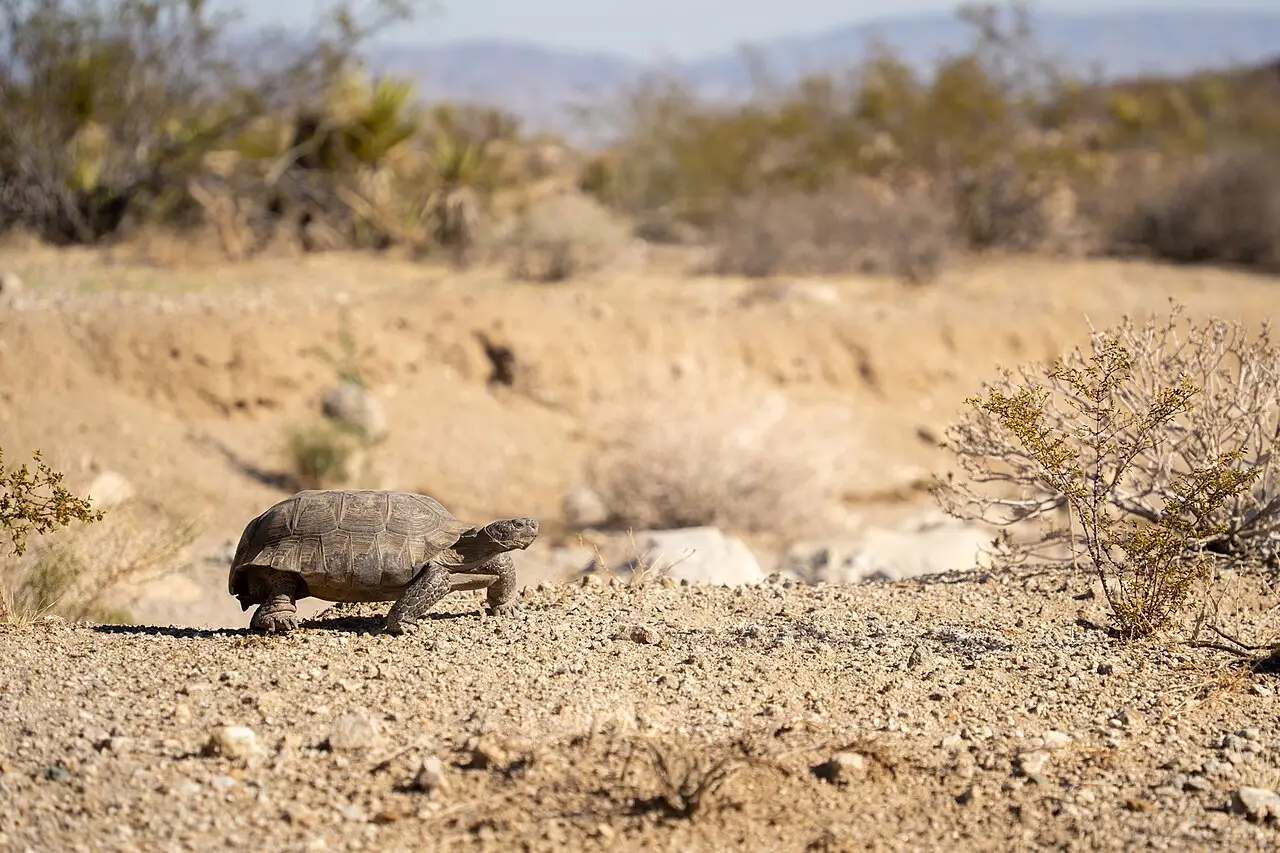
Above: A Mojave desert tortoise walks at the edge of a wash. Credit: NPS/Samantha Laarman, Wikimedia Commons.
For desert tortoises in the western United States, upper respiratory tract disease has been a contributing factor in population decline. New research is shedding light on how temperature and seasonal changes are affecting tortoise immune systems.
On Thursday, April 9th, Franziska Sandmeier, an associate professor at the Colorado State University, Pueblo, and an alumnus of the University of Nevada, Reno, returned to speak at its Ecology, Evolution and Conservation Biology colloquium. She presented research on the “Temperature-dependent and Seasonal Immunology of Mojave Desert Tortoises.”
Sandmeier’s research focuses on upper respiratory tract disease, a widespread illness caused by the bacteria Mycoplasma agassizii. Although this disease is considered nonlethal, it leads to illness in infected tortoises.
“So it might lead to water loss, it can lead to less successful foraging, but unless the cases of disease are really bad, it doesn’t lead to outright death most of the time,” Sandmeier said.
To better understand how tortoises fight infection, Sandmeier’s lab focused on phagocytes and the process of phagocytosis. Phagocytes are white blood cells that are specialized to protect the body from bacteria, foreign particles, and debris. These cells get rid of the bacteria using phagocytosis, locating the bacteria, attaching and ingesting them.
“Phagocytosis is…just gobbling things up and breaking them down,” Sandmeier said.
Her lab conducted laboratory experiments using blood samples from captive tortoises, testing how different immune cells responded across a range of temperatures that mirror seasonal conditions in the wild. By exposing cells to bacteria-sized particles, they measured how effectively each type could attach to and break down potential bacteria.
The results revealed that immune responses vary not only by temperature but also by season. Some cells performed best at cooler temperatures, while others were more active in warmer conditions. Across the board, however, immune activity peaked in the fall. This pattern may reflect how tortoises balance energy use throughout the year.
Sandmeier said these seasonal shifts could be tied to “energetic trade-off with all the other things they do, like eating, nutrition, and reproduction.” Rather than investing heavily in immune defenses year-round, tortoises may rely on behaviors like basking in warmer months to help control infections, before ramping up internal immune responses later in the year.
The findings may also help explain long-standing questions in conservation research about why individual tortoises often show inconsistent signs of disease despite similar exposure levels. According to Sandmeier, immune responses may reflect infections from previous seasons rather than current conditions, making disease patterns harder to interpret.
As researchers continue to untangle how temperature and season influence immunity, Sandmeier said the work highlights how much there is still to learn about even well-studied species.
“These are sort of all the things I’ve always wanted to know from the time I started my PhD,” she said, “and I think I’m finally getting there.”
Zoie Alstad is an undergraduate student in the Department of Chemistry at the University of Nevada, Reno. She is an advocate for undergraduate research at the University and loves to highlight students’ research experiences. She wrote this story for the Hitchcock Project’s Science and New Media course during spring 2026.